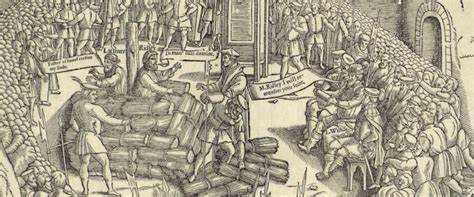
A sermon to remember the bishops and martyrs Latimer and Ridley.
Whatever is true, whatever is noble, whatever is right, whatever is pure, whatever is lovely, whatever is admirable—if anything is excellent or praiseworthy—think about such things.
The prophet Isaiah proclaims to the people of Judah in Isaiah 24 that God will destroy and scatter them, but after he has scattered his people he will gather them up and come to them. Isaiah says in the chapter we heard today (25) that when God comes to them he will do three things. When God comes to them again he will remove the shroud of death from the faithful. They will no longer fear death. It will have no more dominion over them. When he gathers with his people again he will wipe away the tears from their eyes. He will give them comfort. And thirdly when the Lord comes again to them he will set a feast before them in Jerusalem, a feast with new wine and the richest of foods. When we gather to celebrate the Eucharist, we remember the night when Jesus set forth a feast for his apostles before he was handed over to death. In this feast we taste the promise of the heavenly banquet he is preparing for his people.
In October of 1555 a woman named Mrs. Irish wept. A young man who had been under house arrest in their home was to be burned at the stake for his writings on the Lord’s Supper. Nicholas Ridley had argued, in Convocation and in writing, in debates and in pulpits, that Jesus died once upon the cross to save lost sinners like us. That death of our perfect and holy Christ offered once was sufficient to satisfy the justice of God against all who would believe in Jesus. When Henry VIII had died and Edward VI ,age nine, had become the young king, Ridley likened him to a Josiah figure. Josiah was a boy king in the bible who restored Israel to faithfulness under God and destroyed many idols, ended child sacrifice and prostitution as worship. In an Ash Wednesday sermon Ridley called for the full Reformation of the church. They were in a position to bring the good news of Jesus’s sufficient death and the promise of salvation to those who believe to everyone in England. And with God’s help many by faith received the promise in the Lord’s Supper, and heard the Word of God and they became new men and women in Jesus. They heard the bible explained in English for the first time. They read God’s Word. They worshiped him and offered their hearts to him in words they could understand. Six years later that boy king died of tuberculosis and the new Queen, Mary Tudor, after offering a requiem mass for her brother, wanted to punish Ridley for ‘taking advantage’ of her brother. To Mrs. Irish’s tears Ridley answered: though my breakfast shall be somewhat sharp and painful, yet I am sure my supper shall be more pleasant and sweet.
Mary Tudor and her helpers Stephen Gardiner and Reginald Pole insisted that every time a priest celebrated the mass Jesus’s body miraculously became present at the altar and he died a new and fresh death for our new and fresh sins. Because Ridley asserted that Jesus was worthy to redeem the sins of all who would trust in him, that in the Eucharist we receive the promise of the forgiveness of sins, that the miracle of the Eucharist is the transformation of sinners into Christians and a feeding after a spiritual manner upon Christ’s body offered for us he was to be executed.
The Lord sets a table for us in the presence of our enemies.
Hugh Latimer was to be burned along with Ridley in a ditch at Oxford. Latimer was a much older man. He had been in charge of examining candidates for a degree in Divinity to qualify for the priesthood. When Greek sources came to be available in England he grew suspicious of bible-readers. It seemed that those who read the church fathers seemed to be able to get along and accept church teaching and not be trouble makers. But those that read the bible seemed to get all worked up and dissentious. They would cause division and trouble. And so Latimer would direct students away from the bible and to the scholastics and the patristics. He would route out contraband protestant books from the continent and became in his words “as zealous as Paul against the Christians”. Then one day Thomas Bilney came to Latimer under the guise of going to confession. He confessed to him his own divisiveness and that he had read protestant books, but as he shared, he shared the promises of God in Christ Jesus as presented in scripture, and shared that he suspected that is by faith alone in Christ alone known in scripture alone that we might hope to be saved and know real peace with God. Latimer turned and trusted in God and his Word. Latimer from then on became scrupulous about only allowing those who knew this hope and had read the scriptures to graduate and go on into the priesthood.
Latimer as Bishop of Worcester and later as a preacher in London preached that it was not the propitiation worked by the priest on the altar that saves us but the death and resurrection of Jesus accomplished already that saves us. He proclaimed that what we need is not liturgical fussiness to make sure its right, but to trust in Jesus and feast on him according to his promise and in his Word in the reading of scriptures in a language that we can understand. As the two men were to be burnt, Ridley’s brother in law hung bags of gunpowder over their necks. Latimer said: Play the man, Master Ridley; we shall this day light such a candle, by God’s grace, in England, as I trust shall never be put out.
We hear in the gospel (Matthew 22:1-14) the parable of the wedding banquet. The master of the feast asks his noble and dignified friends to come but no one has come so he sends out his servants wherever they can to gather guests to celebrate the feast with him. How many religious leaders had gone before Cranmer and Ridley and Latimer? How many had recited the Latin mass and insisted on their traditions but were unwilling to be changed by the promises set forth in God’s Word? How often do we fail to hear these promises, how often do we fail to trust and follow the invitation given to us by Jesus? If you haven’t heard it before I invite you now, God himself has prepared the best wedding feast. The ox and the fatted calf have been slaughtered and butchered. Everything is made ready. Leave the rest behind. This is more important than your business. This is more important than your wars. Come to the banquet. Put on your wedding clothes and celebrate. Come into his house and be part of his family.
Do not insist on being unworthy, Jesus has borne the blame.
Do not insist on being a servant, God will serve you this meal.
Be a joyful guest and feast, expect in the feasting to become a new person by the promises and power of God.
Whatever is true, whatever is noble, whatever is right, whatever is pure, whatever is lovely, whatever is admirable—if anything is excellent or praiseworthy—think about such things.
 Pacific Pastor
Leave a comment